HR Profession
THE HR PROFESSION – Framework, Competencies & Career Levels
Human Resource (HR) management is a global profession central to organizational success in today’s knowledge-driven economy. It encompasses a broad range of strategic, operational, and advisory roles across public and private sectors, requiring a combination of technical expertise, business insight, and human-centered leadership. HR practitioners play a critical role in talent strategy, workforce enablement, culture building, legal compliance, performance optimization, and organizational transformation.
Human Resource Management Institute
As the global HR landscape matures, it is increasingly governed by standardized competencies and professional pathways that reflect international best practice and workforce expectations, enabling individuals and organizations to benchmark, develop, and certify HR capability consistently worldwide
Three Levels of HR Profession (Aligned with Global Technical Competence Standards)
To support structured career progression, the HR profession is classified into three primary levels, each with distinct roles, responsibilities, and competency expectations appropriate to experience, scope, and impact:
1. Entry & Operational HR Level — Foundational Professional
Role Focus: Execution of core HR processes, compliance, and people support.
Typical Roles:
-
HR Associate / Coordinator
-
HR Generalist
-
HR Administrator
-
Recruitment Specialist
-
Learning & Development Specialist
Core Competencies Required:
-
HR operations and compliance fundamentals
-
Employee lifecycle management
-
Talent acquisition and onboarding
-
Payroll, benefits and administrative systems
-
Data literacy for HR reporting
Competence Standards Emphasis:
At this level, practitioners should demonstrate technical proficiency in key HR functions and apply standard HR policies and procedures with accuracy and consistency. Embedded professional behaviors include ethical practice, reliable execution, and relationship management.
2. Mid-Level HR Leadership — Strategic Practitioner
Role Focus: Integration of HR practices with organizational priorities; lead HR programs and change initiatives.
Typical Roles:
-
HR Manager / Senior HR Manager
-
Talent & Performance Manager
-
Organizational Development Specialist
-
Learning & Leadership Development Lead
-
Workforce Planning Analyst
Core Competencies Required:
-
Strategic HR management and planning
-
Performance management and development frameworks
-
Change management and culture enhancement
-
Workforce analytics and modeling
-
Coaching and people leadership
Competence Standards Emphasis:
At this level, practitioners are expected to contribute to strategic goals, lead cross-functional HR initiatives, and translate people data into insights that drive business outcomes. Competency development includes business acumen, digital agility, organizational influence, and leadership capabilities
3. Executive & Global HR Leadership — Transformational Strategist
Role Focus: Provide executive HR leadership, align people strategy with enterprise vision, and drive competitive advantage through human capital excellence.
Typical Roles:
-
Certified Human Resources Director (CHRD®)
-
Certified Chief Human Resources Officer (CHRO®)
-
VP / Head of HR, People & Culture
-
Global HR Business Partner
-
HR Governance & Strategic Advisory Lead
Core Competencies Required:
-
Executive leadership and governance
-
Strategic workforce planning at scale
-
Enterprise risk management and compliance
-
High-performance organization design
-
Ecosystem and stakeholder value optimization
Competence Standards Emphasis:
At the executive level, HR leaders are expected to act as strategic partners to the Board and CEO, shape organizational direction, and steward culture, agility, and sustainability. Skills such as corporate governance, executive decision making, systemic transformation, and global HR leadership are essential.
This level aligns with global technical competence frameworks that define proficiency in strategic integration, people-centric innovation, and enterprise-wide performance leadership
Role Pathways & Integration of Specialist Work
Across all levels, HR professionals may also pursue specialist roles focusing on niche domains—such as talent acquisition, compensation & benefits, industrial relations, global mobility, HR analytics, workplace safety, and organizational development—while anchoring their career progression within the broader HR competency framework.
Additionally, seasoned practitioners often transition into external roles as consultants, advisors, or independent HR strategists, supporting organizations with outsourced HR services, regulatory compliance, and capability development.
Competency-Driven Career Development
Modern HR careers should be guided by competency frameworks that articulate knowledge, skills, behaviors, and performance standards at each proficiency level. Frameworks such as the T-shaped HR model emphasize core business acumen, digital agility, data literacy, people advocacy, and execution excellence as foundational across the profession.
These frameworks also highlight the need for continuous upskilling in areas such as strategic workforce planning, HR technology adoption, organizational culture design, and sustainable human capital management—ensuring HR professionals remain relevant and value-creating in the future of work.
HRMI’s Role in Professionalizing the HR Career
The Human Resource Management Institute (HRMI®) advances the HR profession globally by setting standards, accrediting credentials, and building HR capability through research, certification, and professional recognition. Its model of excellence combines expected competencies, behaviors, and industry standards, and aligns them with roles across the HR career spectrum—from foundational practitioners to strategic HR leaders.
Through certification pathways such as CHRP®, CHRM®, CHRD®/CHRO®, and CHRC®, HRMI supports lifelong career development, enabling professionals to demonstrate competence, advance career stature, and contribute meaningfully to organizational and societal success.
EXTERNAL ROLES
External HR roles can be either generalist or specialist. Often practitioners who have been in the profession for some time and have experience in a particular area or industry will choose to go out on their own as a consultant providing outsourced HR services to an organization.
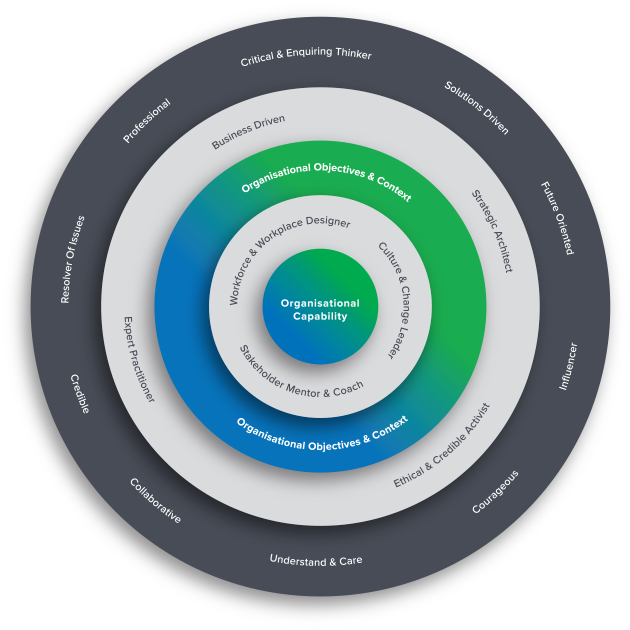
HRMI MODEL OF EXCELLENCE
The HRMI Model of Excellence is a graphic representation that combines what HR practitioners should know, what they are expected to do, and what their peers expect them to be in terms of behavior and capabilities.
The circles of the graphic sets out 10 behavior and seven capabilities that were confirmed as essential for HR practitioners in the most recent 2008-2017 HRMI member surveys.